The indigo alphabet: how adire patterns say what words don't.
In Yoruba, "adire" means "tied and dyed" — but the tying was never just technique. Every fold, stitch, and paste-drawn line is a phrase. Here's how to read the cloth on your shoulders.
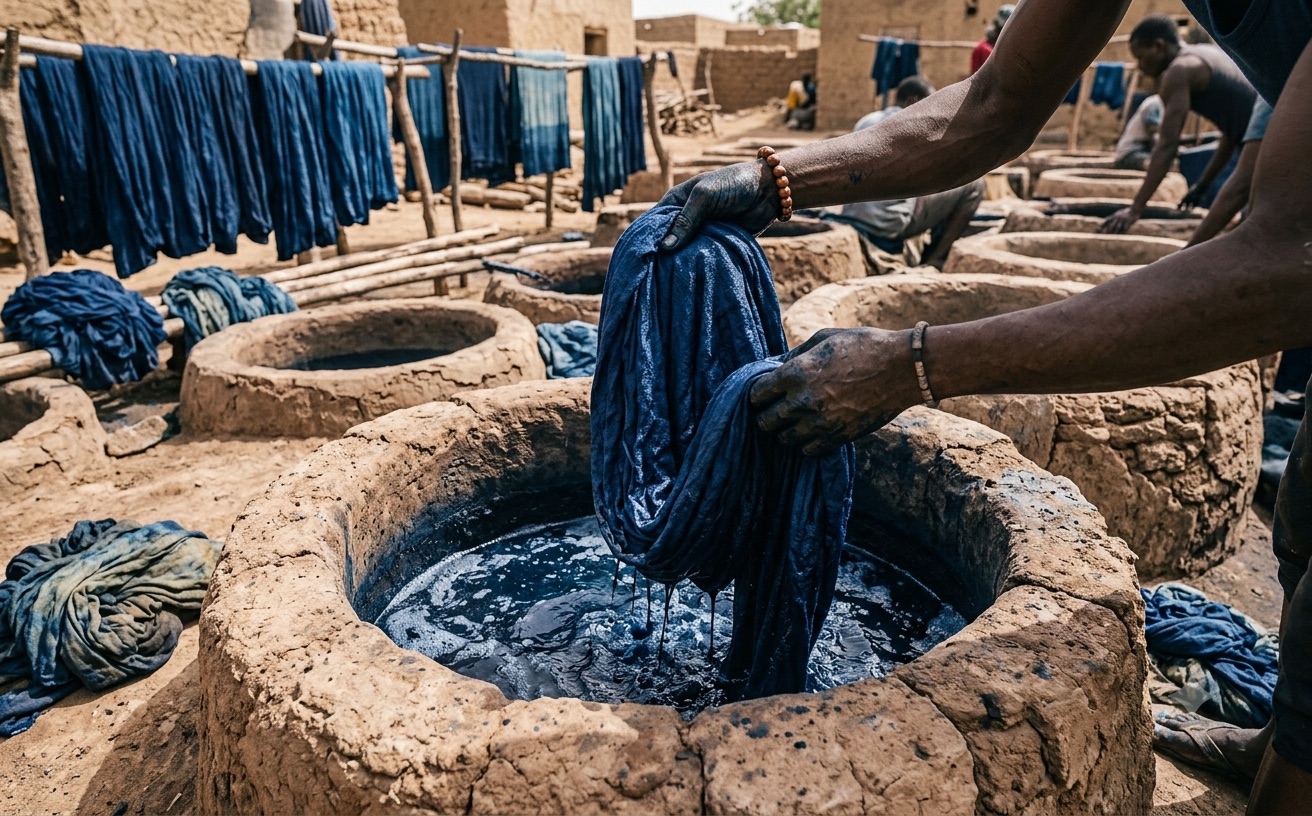
Walk through Itoku Market in Abeokuta on a dyeing day and you'll smell the indigo before you see it — green-earthy, slightly sweet, rising off clay pits that some families have kept fermenting for generations. The dyers, almost all women, work elbow-deep in a liquid that looks black until cloth comes out of it, dripping green, then oxidizing to blue in the air in front of you.
The cloth comes out green and turns blue as it breathes. The first time you see it, it looks like a magic trick. The hundredth time, too.
A pattern is a sentence
Traditional adire patterns carry names and meanings that function like proverbs. Ibadandun — "Ibadan is sweet" — celebrates a city. Olokun honors the goddess of the sea and wealth. A bride might receive cloth whose pattern wishes her prosperity; a woman navigating a dispute might wear a pattern that says, without a word being spoken, exactly what she thinks.
The vocabulary comes from technique. Adire oniko is tied — raffia bound around stones and seeds to resist the dye in rings and bursts. Adire alabere is stitched — needlework pulled tight before dyeing, leaving fine lines like handwriting. And adire eleko, the technique behind our indigo wrap, is painted — cassava-starch paste drawn freehand or through zinc stencils, each protected area emerging pale against ten baths of deepening blue.
Ten dips deep
Depth of color is depth of labor. A pale sky-blue may be two immersions in the indigo pit; the near-midnight ground of a fine adire is eight to ten, with oxidation time between each. There are no shortcuts — synthetic indigo exists, but the workshops we buy from ferment their own vats from indigofera leaves, ash, and time, the way their grandmothers did.
This is why no two wraps we ship are identical, and why we photograph the actual batch each time. The cloth you receive was individually folded, painted, and dipped by a person whose name is on the label — most often from Alhaja Ramotu's workshop, four women whose stall sits third from the entrance of Itoku's dyeing row.
Reading yours
- Rings and sunbursts — tied resist; each circle held a stone or seed.
- Fine parallel lines — stitched resist, unpicked by hand after dyeing.
- Painted motifs and grids — cassava-paste work, the signature of adire eleko.
- Slight blurring at the edges — not a flaw: it's where the indigo breathed under the resist. Machine prints never blur.
That blur is the point, really. It's the difference between cloth that was made and cloth that was manufactured — the trace of a hand you can name.