A day at the looms of Bonwire, where kente is still a family verb.
Bonwire, a town in Ghana's Ashanti Region, has been weaving kente for royalty for over three centuries. We spent a day in one shed with four generations of one family. These are the notes.
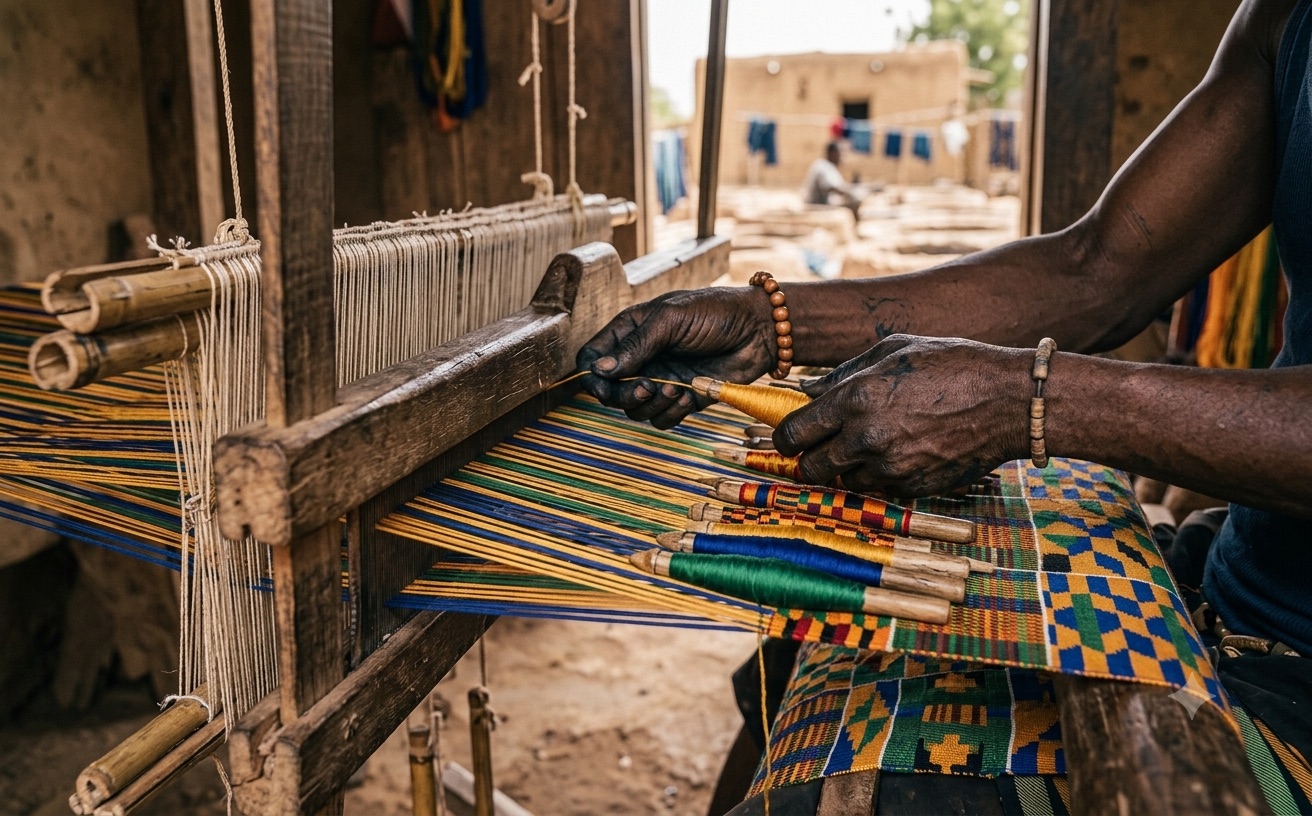
The sound arrives before the shed does: a dry wooden percussion, dozens of shuttles and heddles clacking in loose polyrhythm, like rain on a tin roof slowed down. Inside, sixteen looms sit in two rows, each one a narrow wooden frame the weaver wears as much as operates — strung to his hands and, through a pair of cords, to his toes.
Kwabena is seventy-one and has woven at the same position by the east wall since he was fourteen. His grandson, twenty-two, weaves three looms down, one earbud in. Between them: a son, a nephew, and the fourth generation — a nine-year-old who after school winds bobbins and watches everything.
"Everyone asks how long a cloth takes. Wrong question. Ask how long a weaver takes. The cloth is quick — it's the weaver that took fifty years."
Four inches at a time
Kente is not woven as a sheet. It's woven as a strip — about four inches wide and up to four meters long — and a full cloth is twenty-four strips, each woven separately and then sewn edge to edge so precisely the joins disappear into the pattern. The mathematics are done entirely in the weaver's head: a misalignment of a few threads in strip nineteen would break the pattern across the whole cloth.
The pattern Kwabena was finishing when we visited — a dense double-weave his family calls by a name that translates roughly to "one man cannot rule a country" — took him eleven days of full-time work. It's the lineage behind the ceremony stoles in our collection: same shed, same silk-and-cotton blend, patterns chosen by the family for meanings they're willing to send abroad.
What "direct" means in practice
The family sets the price per strip before the loom is warped. We pay half up front — materials and living costs while the work happens — and the balance on completion. Their names travel with the cloth: the label on a Mara stole reads the weaver's name, the shed, and the year, the way a painting is signed.
When a pattern sells out and we reorder, the originating weaver earns on the rerun even if a younger hand does the weaving. That rule came from Kwabena himself, negotiated with a smile that suggested it was not negotiable.
The nine-year-old
Near closing, the youngest was allowed twenty minutes at the smallest loom, feet barely reaching the cords, tongue out in concentration, producing four wobbly inches of plain weave that his great-grandfather inspected with total seriousness and pronounced "acceptable for a Tuesday."
Three centuries in, that's the supply chain. We just try not to get in its way.