The art of the slow pour: finding solace in five minutes.
Pour-over gets treated like a science exam — scales, timers, spreadsheets of ratios. We think that misses the point. Here's our case for brewing as a five-minute ritual, and the only technique you actually need.
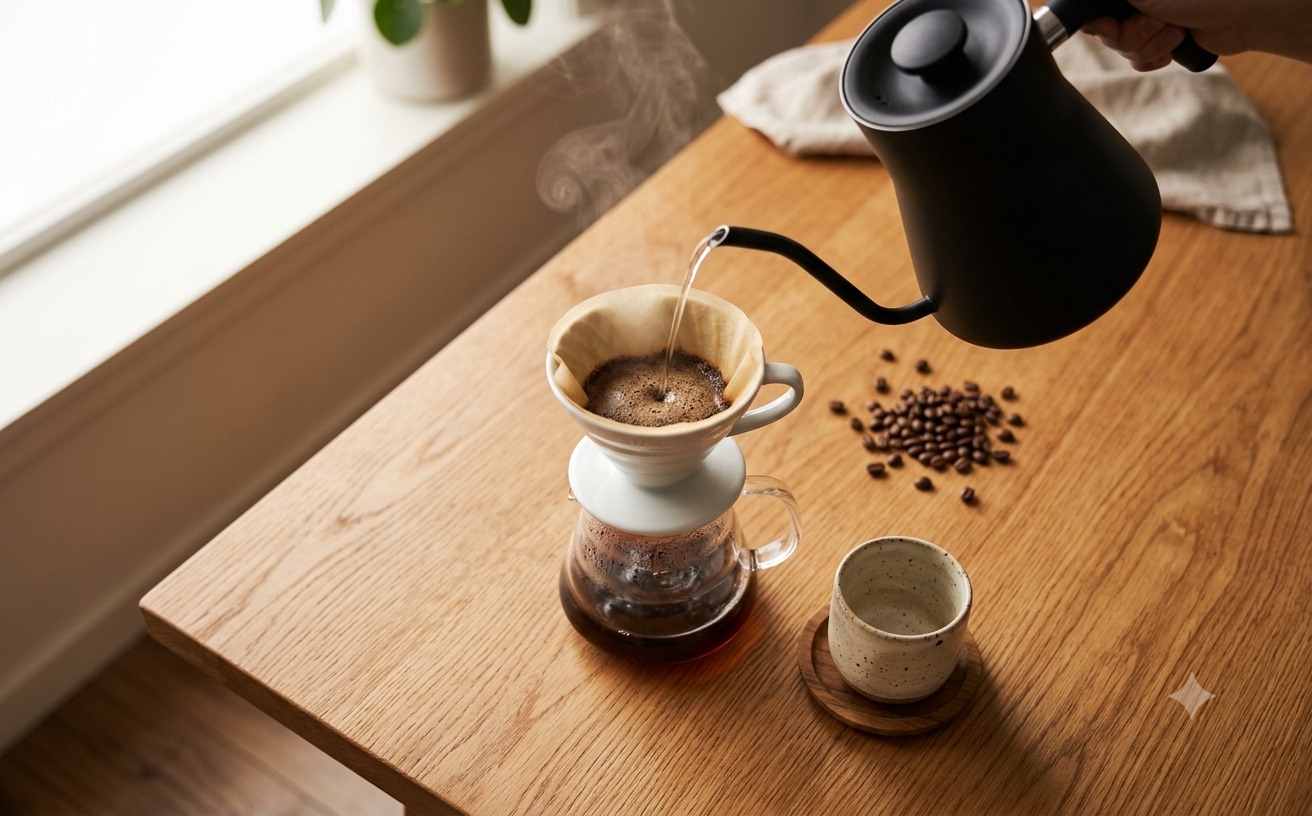
There's a version of coffee culture that turns every morning into a laboratory: 1:16.4 ratios, bloom timers, TDS meters. We respect it. Some of the best cups we've ever tasted came from people who weigh their water to the gram. But that's not why most of us started drinking coffee, and it's certainly not why we started roasting it.
Pour-over isn't a method. It's the one part of the day that refuses to be rushed.
The slow pour works because it can't be multitasked. For three to five minutes, your hands are busy, your attention is on the water, and your phone is on the other side of the kitchen. That's the entire secret. The coffee is almost a byproduct.
The only technique you need
If you have our coffee, a basic dripper, and any kettle you can pour slowly from, this is enough:
- Use more coffee than feels right. Two generous tablespoons per cup. Weak coffee is the most common failure, and it has nothing to do with technique.
- Wet the grounds, then wait. Pour just enough water to soak them, count to thirty. The grounds will puff and bubble — that's the roast releasing gas. Fresh coffee does this. Stale coffee doesn't.
- Pour in slow circles. Not because the circles matter much, but because it keeps you present. Finish in about three minutes.
- Drink it before you do anything else. This is the step everyone skips.
What to brew this way
Lighter, floral coffees reward the slow pour most — the method's clarity lets delicate notes through that a French press would muddy. Our Hambela Estate from Sidamo is the one we reach for: jasmine and bergamot up front, a white-peach sweetness underneath, and a tea-like finish that only shows itself when you're paying attention.
Which, in the end, is the whole idea.